

Credit: Kristina Ttripkovic
Not familiar with guiltwashing? SHAME ON YOU!
Most Americans—whether they know it or not—have been the target of guiltwashing, a term used to describe an insidious form of psychological manipulation designed to obfuscate the nefarious intent of the perpetrators, mainly large corporations and institutions. Probably the most effective weapon of mass deception (WMD), guiltwashing is a form of corporate blame-shifting where companies weaponize guilt to make individuals feel personally responsible for systemic problems corporations themselves are causing. It’s a psychological hand job—turning societal harm into a question of moral failure. Didn’t recycle that plastic container? What about exceeding your carbon footprint? Then you are to blame for climate change, not the multinational corporate gangsters polluting earth’s biosphere with plastics, pesticides, oil, and toxic chemicals at alarming rates. Climate change is also a completely fabricated scam designed to line the pockets of global elites.
The Dead Zone: Not An Ideal Spot for Snorkeling

Dr. Jill Tupitza and Allison Noble measuring oxygen levels in the Gulf of Mexico’s hypoxic zone. Credit: Cassandra Glaspie, LSU
For example, take the approximately 6,705 square mile dead zone—or hypoxic zone, an area of low oxygen—located in the body of water formerly referred to as the Gulf of Mexico, a figure that equates to more than 4 million acres of habitat unavailable to fish and bottom species. This toxic expanse, an area roughly the size of New Jersey, is the result of inorganic fertilizer, pesticides, and herbicides like glyphosate that drain into the Mississippi River from adjacent farmlands which then empties into the Gulf Stream where it wipes out bird and marine life. Here, the guiltwashing sleight of hand has keenly shifted the blame, purporting that the Gulf’s dead zone is not the result of the multibillion-dollar fertilizer and pesticides industries skirting regulations and ignoring health and environmental concerns, but the consequence of people like you and me livingthousands of miles away who are demanding that companies like Mosaic and Bayer (formally Monsanto) increase the development and use of toxic chemicals to meet our food production needs. Bon appétit!
Guiltwashing the Unvaccinated
When it comes to shaming people into rolling up their sleeves and accepting an untested, unsafe, and ineffective vaccine, the government, big pharma, and their cohorts in the corporate mainstream media pulled out all the stops. It was an all-out
war on the unvaccinated, and many will recall the endless parade of know-nothing, unqualified pro-vaccine big pharma watercarriers, especially the friends and family members of the millions who suffered debilitating injuries and died from submitting to a deadly Covid vaccine and subsequent boosters.
Years before Covid-19 was on the world’s radar, the Rockefeller Foundation developed Operation Lockstep, a document published in 2010 which outlines planned narratives for introducing a global pandemic and creating mass chaos with the intent of cultivating a world of tighter top-down government control and more authoritarian leadership, with limited innovation and growing citizen pushback.
A section of the plan titled The Scenario Narratives details chilling scenarios for implementing control and world domination by the power elite. The first time I read the Rockefeller document, I sat for several minutes and tried to imagine the collective mindset that spends days, if not weeks or months, hashing out these twisted narratives. What disturbed me the most is that they were written with complete and total impunity, free of the slightest bit of concern for the effects these psychotic scenarios might have on the general populations of the world. It was if they were concocting a plan to herd, capture, and corral all the animals in the rainforest into a gigantic open-air encampment, assuming they would obediently follow their commands at the sound of a whistle.
Mass Formation
If Operation Lockstep was developed in 2010, one might ask, Why did it take an entire decade to implement? They had all the resources; God knows they had all the money in the world. What was missing? I believe it was the social climate in the mid-2000s, a period when America was still recovering from 9/11 and the financial crisis in 2008. At that time, the globalists had attempted to introduce a pandemic as planned, but preliminary analysis indicated that the populace was psychologically splintered, and the collective consciousness wasn’t quite ready to accept a full-scale global medical crisis. For people to join together en masse, explicit conditions must be in place, conditions that had emerged in 2020.
In his widely popular 2021 book, The Psychology of Totalitarianism, Mattias Desmet, professor of psychology at the University of Ghent (Belgium), details the concept of “mass formation.” In a series of illuminating interviews, Professor Desmet describes his experience and discusses this global phenomenon that emerges in a society when at least four very specific conditions are fulfilled:
First condition: The first and most important condition is that there should be a lot of people experiencing a lack of social bonds, a lack of social connectedness.
Second condition: There has to be a lot of people who experience a lack of meaning making in their life.
The first and second conditions are closely associated with each other. Humans are social beings, and if they feel a lack of social connectedness, a lack of social bond, they will more than likely also experience a lack of meaning in their jobs, community, and life in general.
Third condition: Many people would need to experience free-floating anxiety and psychological discontent. That is, anxiety that is not connected to a mental representation. For instance, if you find yourself surrounded by a pack of wild hyaenas, you are scared, and you know what you’re scared of. Your anxiety, in this case, is connected to a mental representation. But free-floating anxiety, arguably the most distressing and debilitating, is not connected to a mental representation.
Fourth condition: The fourth condition occurs as a result of the first three conditions. When the first three are present, a population will experience a lot of free-floating aggression. People feel socially disconnected and that their life makes no sense, a breeding ground for frustration, anger, and free-floating aggression.
When Covid-19 hit the airwaves, people suddenly had meaning, purpose, and a collective enemy they could focus on en masse. This time it wasn’t goosestepping Germans, it wasn’t the sneak-attacking sushi-eating Japanese, or a bunch of gruff-speaking humorless commies in Russia out to take away our freedoms. No—it was an invisible deadly virus attributed to a number of dubious sources of origin. The perfect enemy established to have people pointing fingers at each other.
Nothing Was Left to Chance
Operation Lockstep set the tone and direction for similar globalist schemes like Event 201, the demonic tabletop pandemic simulation exercise hosted by the World Economic Forum and the Bill and Melinda Gates Foundation that took place in New York City in September 2019, six months prior to the March 2020 announcement of the Covid-19 “pandemic.”
Convincing the people of the world that a pandemic was looming and that they needed to submit to an untested, emergency-use medical intervention to save themselves and others was a colossal challenge, one that needed careful analysis and psychological techniques to enlighten the masses. To ensure the “limited innovation and growing citizen pushback” described in Operation Lockstep, the government turned to academic institutions and initiated grants for programs, studies, and surveys to determine public sentiment and the psychological framework needed to pressure people of all stripes and colors to accept the Covid vaccine. It was around this time that labels and terms like antivaxxers and vaccine hesitancy suddenly entered the cultural lexicon which immediately kicked off an us-against-them social dichotomy that provided a solid, surefire outlet for the socially disconnected. (Are you vaccinated? Put on your face mask, asshole! What the hell is wrong with you?)
💉 The MIT Sloan School of Management
In February 2021, The MIT Sloan Office of Communications published an article titled, “Vaccine hesitancy and public health communications: New global study from MIT shows the power of accurate information to increase vaccination rates worldwide.”
The article starts out by hyping the safety of vaccines at a time, early on in the plandemic, when the Food and Drug Administration (FDA) had approved Emergency Use Authorization (EUA) which allowed rush-to-market pharma giants like Pfizer, Merck, and Moderna to forgo long-term testing of their toxic, gene-altering mRNA vaccines while giving the thumbs-up for voluntary reporting of vaccine injuries in the Vaccine Adverse Event Reporting System (VARES), a national database cosponsored by the FDA and the Center for Disease Control (CDC).
Despite the availability of multiple safe vaccines, vaccine hesitancy may present a challenge to successful control of the COVID-19 pandemic. Moreover, and perhaps more importantly, vaccine hesitancy may be caused not simply by fears about the safety or efficacy of the vaccine, but instead by the inaccurate belief that many of your peers or social cohort are not being vaccinated.
The article features some of the study’s highlights:
After studying the responses of over 300,000 people in 23 countries, the study showed that accurate information about descriptive norms can substantially increase intentions to accept a vaccine for Covid-19, reducing the fraction of people who are “unsure” or negative about accepting a vaccine by 5 percent. In other words, clear and accurate information about the behavior of others can influence behavior in a positive way.
Included in the article is a quote from MIT Sloan Professor Sinan Aral of the MIT Initiative on the Digital Economy who co-authored a paper entitled “Surfacing Norms to Increase Vaccine Acceptance.”
While public health officials and the media have been emphasizing the potential negative impact of vaccine hesitancy, our study found that emphasizing the overwhelming vaccine acceptance expressed by most people is a better way to get those who are unsure to accept COVID-19 vaccines.
💉 The Stanford Center for Continuing Medical Education (CME)
In June 2021, the Stanford CME adopted a course framework from Kaiser Permanente and developed an extensive program outlining detailed techniques for having patient-centered discussions about COVID vaccines, or more aptly stated, how to convince people to roll up their sleeve and submit to an untested intramuscular medical intervention without even realizing it.
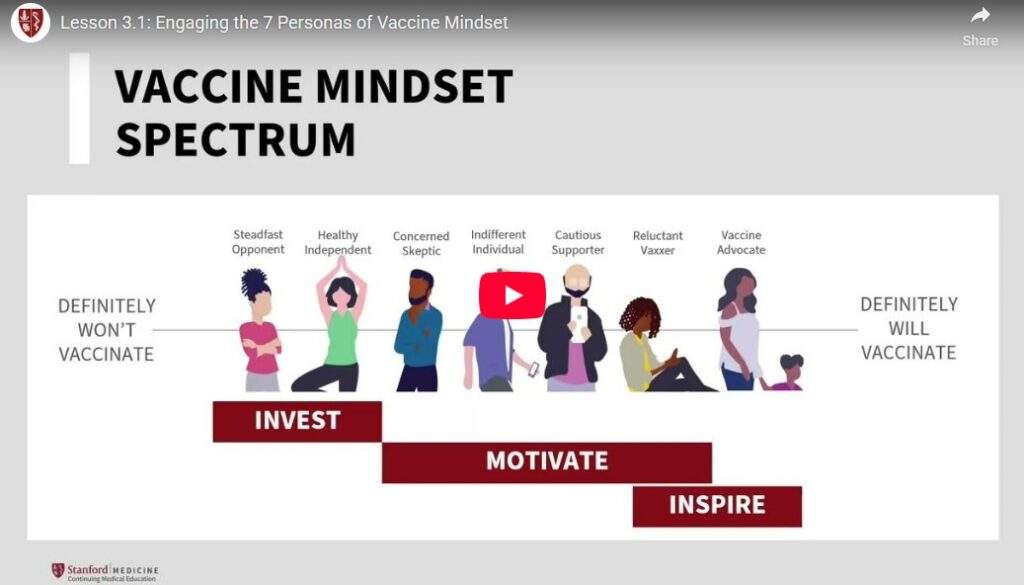
Credit: The Stanford Center for Continuing Medical Education (SCCME)
The Stanford CCME course provides nine lessons, each with an animated video presentation. The ninth lesson, titled Reluctant Vaxxer, lists a three-part outline for identifying and addressing pesky individuals who are reluctant to submit to a vaccine:
Part 1: Background. We examine the considerations common to people who fit this persona.
Part 2: Encounter. In this animated patient encounter about the COVID vaccine, we demonstrate patient-centered communication strategies – both persona-specific opportunities for influence, as well as general motivational interviewing techniques.
Part 3: Takeaways. We analyze the previous animated patient encounter and what communication strategies the clinician applied, including persona-specific opportunities for influence, as well as general motivational interviewing techniques.
The course objectives are listed on Stanford’s CME’s website:
At the conclusion of this activity, learners should be able to:
1- List the concepts driving vaccine attitudes and behaviors
2- Describe the mindset of 7 personas of COVID-vaccine-hesitant patients that have been identified through research
3- Apply individualized and targeted opportunities for influence as demonstrated through a series of animated patient encounters
“Targeted opportunities.” How wonderful. This program reads like a walk-in human petri dish cooked up by Dr. Josef Mengele. I wonder if the patients subjected to these maniacal interviewing techniques are aware and informed about the sick folks who developed them.
💉 Yale University School of Medicine
In November 2021, Yale University News published an article titled “Appeals to community spirit, shame most likely to shift vaccine attitudes.” The article announced, “a new Yale study investigates what types of public health messages are most effective at convincing people to get the COVID-19 vaccine.”
Just to be clear—that’s Yale University, one of the top ten Ivy League schools, home of the elite Skull and Bones cult and the breeding ground for cultivating US presidents, industrialists, CEOs, and future heads of the CIA.
Without the slightest hint of moral conviction, the article states:
Pro-vaccine messages that appeal to community spirit or evoke the sense of embarrassment people would feel if they were to spread COVID-19 to friends and family are effective in persuading individuals to get vaccinated and encourage others to do the same, according to a new Yale study.
The study, published in the journal Vaccine, incorporates two survey experiments to gauge how a broad range of messages affect people’s intentions to get vaccinated, their willingness to persuade those they care about to get the shots, and their judgments of individuals who decide against receiving the vaccine.
Utilizing a sharply crafted survey, researchers tested eleven messages for effectiveness that ultimately identified three messages determined to be most effective in persuading people to get vaccinated, encourage others to do so, and negatively judge those who go unvaccinated. As the article explains:
One appealed to people’s sense of community and the need to work together to protect everyone through vaccination; another combined the pro-community message with an evocation of the embarrassment one would feel if they got someone close to them sick after refusing the vaccine; and a third emphasized that there is nothing brave about ignoring public health advice and refusing the vaccine.
There is nothing like invoking shame in people as an effective means of encouraging them not to think for themselves or to question authority.
Gregory A. Huber, the Forst Family Professor of Political Science in Yale’s Faculty of Arts and Sciences and a co-author of the study shamelessly affirmed the intent and effectiveness of the study:
Our work shows that messages emphasizing collective action on behalf of the community, combined with the notion of reciprocity, are effective in persuading individuals to say they will get vaccinated and encourage others to get the vaccine. It also was interesting that emotional appeals, such as evoking embarrassment, motivate people to reach out to others. That second-level effect — encouraging others to get vaccinated — is likely very important to increasing the vaccination rate.
In a recent video presentation, Mike Benz, former official with the US Department of State and current executive director of the Foundation For Freedom Online, provides a concise breakdown of Yale’s messaging survey that, according to Benz, analyzed the participation of 4,000 people. In his presentation, Benz offers an astute observation regarding the survey’s personal freedom message whichstates, “By working together to get enough people vaccinated, society can preserve its personal freedom.”
One fifteenth of the sample will be assigned to this intervention, which is a message about how COVID-19 is limiting people’s personal freedom. Well, society doesn’t have personal freedoms. Individuals in societies have personal freedoms. That’s what the personal in personal freedoms stands for.
Yale’s Dark Track Record of Psychological Studies
When it comes to academic institutions working with the US government on developing insidious interviewing techniques, Yale University is no stranger. In 2013, Democracy Now reported:
Students and alumni at Yale University are organizing against a proposed campus center to train special operations forces in interview techniques. The center would be funded by a $1.8 million grant from the Pentagon and could open as early as April. Dubbed an “interrogation center” by critics, the facility would be housed at the Yale School of Medicine and led by Charles Morgan, a professor of psychiatry who previously conducted research on how to tell whether Arab and Muslim men are lying.
Hey—no guilt or shame in these Halls of Ivy.
NOW EVERYBODY SING!