
The 20th-Century Blueprint for Achieving Real Freedom and National Sovereignty in the age of No Kings and the Activist Industrial Complex.
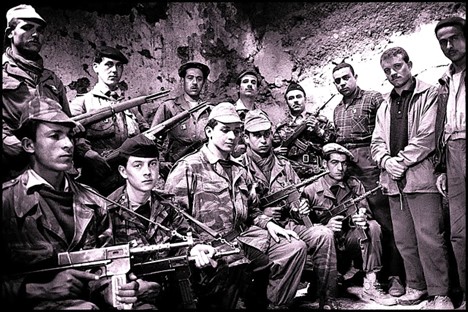
The War in Algeria. Platoon of FLN troops. Kabylie, Algeria. 1962. Credit: Philip Jones Griffiths
Algeria, Africa’s second largest country, was colonized by the French in the 19th century and under French colonial rule for 132 years. Unlike the neighboring French protectorates of Tunisia or Morocco, Algeria was considered French territory, legally a mere extension of mainland France. By the mid-20th century, Algeria was home to more than a million European settlers who enjoyed the privileges of French citizenship while the overwhelming majority of the population, Arab and Berber Muslims, reaped few benefits from the French presence. The majority of the native population did not have the same rights as those maintained by French citizens, including the fundamental right to vote in elections. The Crémieux Decree of 1870 granted citizenship to Algerian Jews but excluded Muslim Algerians from full citizenship rights.
Much like the Israeli view of Palestinians, Iranians, and Lebanese, Arabs and Muslims were thought of as subhuman, barbarians who didn’t look, speak, and act like their colonial oppressors and didn’t share the same morals, cultural values, and standard of living.
Easily identifiable by their darker skin color and traditional attire, the majority of native Algerians residing in the capital of Algiers lived in the Casbah, a section of the city dotted with security checkpoints requiring natives to produce IDs and submit to body searches to enter the French-occupied sectors of the city. In the mid-1950s, the Casbah became a stronghold of the Algerian nationalist movement known as the National Liberation Front (FLN).
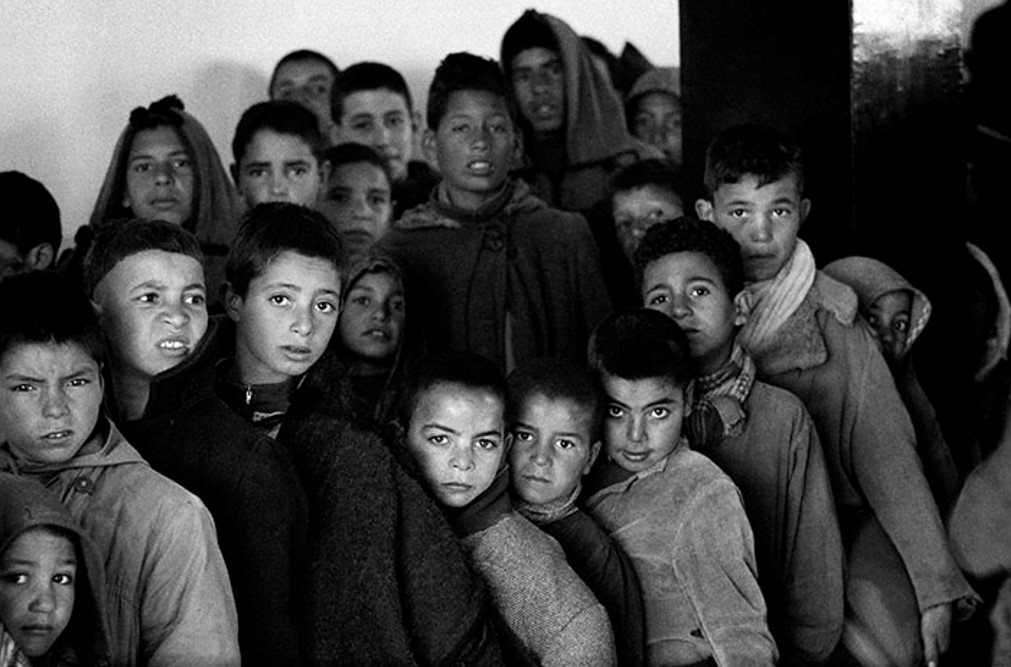
The War in Algeria – Algerian school children seeking refuge over the border in Tunisia near the town of Sakiet. Credit: Philip Jones Griffiths
The Algerian revolution was a decisive victory after eight years (1954–1962) of sacrifice and bloody confrontations with occupying French forces. Reminiscent of the Palestinians’ struggles in Gaza and the West Bank, the Algerian Revolution is widely regarded as a blueprint for defeating the unbridled arrogance and brutality of colonialism and attaining sovereignty and national independence.
The Algerian revolution caused the deaths of between 400,000 and 1.5 million Algerians, 25,600 French soldiers, and 6,000 Europeans. War crimes committed during the war included massacres of civilians, rape, and torture; the French destroyed more than 8,000 villages and relocated more than 2 million Algerians to concentration camps. Upon independence in 1962, 900,000 European Algerians (Pieds-Noirs) fled to France within a few months for fear of revenge from the FLN.
Calling Out the Hypocrisy
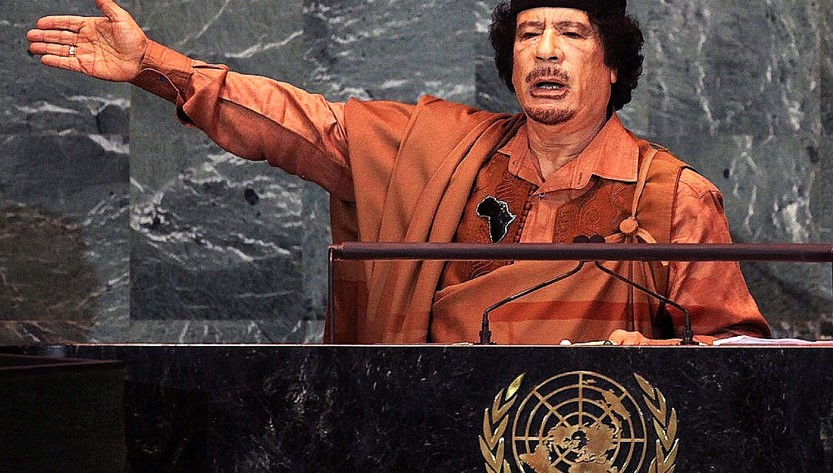
Colonel Muammar al-Gaddafi at the UN, September 2009, Credit: Libyan Free Press / Sottotitoli ITA
Following Algeria’s independence from France, the 1962 United Nations Security Council Resolution 176 recommended Algeria for UN membership. Zero members voted against the resolution, ten council members voted in favor, and one member nation, the United States, abstained. The same United States of America that—along with France and 50 other countries—voted against the UN’s 2022 resolution condemning the glorification of Nazism.
Today, the façade of the United Nations has all but crumbled, revealing its true purpose as nothing more than a globalist organization established to maintain imperialist power and control over the nations of the world. It is now 2026 and the world is watching in horror as the unrestrained US-supported Israeli genocide in Gaza continues to kill, injure, poison, and starve tens of thousands of innocent men, women, and children. The same two imperialist bloodthirsty nations that have attacked the sovereign nation of Iran killing its democratically elected leader, bombed schools and hospitals, destroyed bridges and other critical infrastructure, and killed more than 2,000 Iranian citizens.
In his infamous September 23, 2009 mic drop performance at the UN General Assembly, the late Colonel Muammar Muhammad Abu Minyar al-Gaddafi, Libya’s “Brotherly Leader and Guide of the Revolution,” stunned the 200+ delegates seated in the UN General Assembly. In a calm contemplative tone, his message was clear and his penetrating summation was understood by every subordinate leader in the room, none of whom would dare acknowledge or repeat Gaddafi’s words in the presence of the five permanent membersof the Security Council, the powerful political and economic nations that ultimately control the direction and decision-making of the UN.
We are 192 nations and countries, and we are like Speakers’ Corner in London’s Hyde Park. We just speak, and nobody implements our decisions. We are mere decoration, without any real substance. We are Speakers’ Corner, no more, no less. We just make speeches and then disappear. This is who you are right now.
Holding up a copy of the UN Charter created in 1945, Gaddafi referred to the charter’s preamble.
They created the charter, of which I have a copy. If one reads the charter of the United Nations, one finds that the preamble of the charter differs from its articles.
The preamble says that all nations, small or large, are equal. Are we equal when it comes to the permanent seats? No, we are not equal.
The preamble states in writing that all nations are equal whether they are small or large. Do we have the right of veto? Are we equal?
It says that arm[ed] force shall only be used in the common interest of all nations, but what has happened since then? Sixty-five wars have broken out since the establishment of the United Nations and the Security Council. Sixty-five since their creation, with millions more victims than in the Second World War.
Are those wars and the aggression and force that were used in those 65 wars in the common interest of us all? No, they were in the interest of one or three or four countries, but not of all nations. That flagrantly contradicts the charter of the United Nations.
It was hypocrisy that brought about the 65 wars since the establishment of the United Nations.
Muammar Gaddafi’s Final Moments
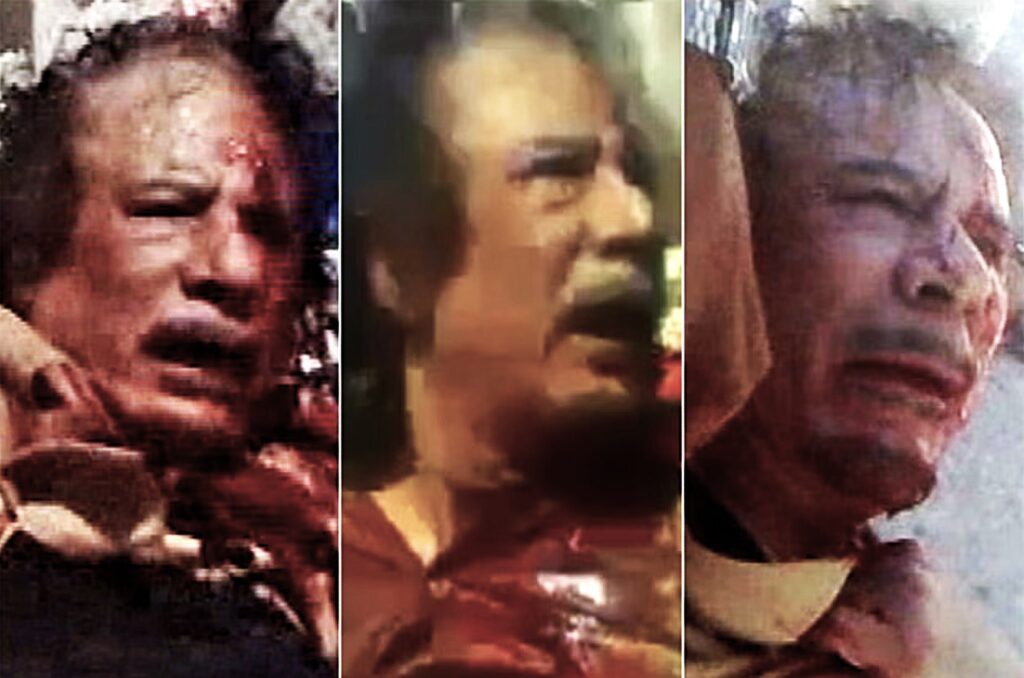
Credit: Human Rights Watch
Nearly two years after Muammar Gaddafi’s UN presentation, he was assassinated on October 20, 2011. To say that his termination was horrific would be an understatement. A 2012 article published by the Independent details an account by Human Rights Watch (HRW) that paints a different, more gruesome picture of Gaddafi’s assassination:
The report claims that at least 66 members of Gaddafi’s convoy were summarily executed by the militias after their capture—a war crime, one which the Libyan civilian and military authorities have an obligation to investigate. To date, they have shown no inclination to do so. And while the Libyan authorities claim that Gaddafi himself was killed in crossfire during the final battle, the evidence amassed by Human Rights Watch (HRW) strongly suggests that he was effectively lynched. The testimony includes an admission by a key militia commander that ‘the situation was a mess … it was a violent scene … it was very confusing.’ Cellphone footage obtained by the organization shows that among other injuries he was stabbed in the anus, probably with a bayonet.
The death of Gaddafi and the overthrow of Libya saddened many people, especially the thousands of Libyan refugees who fled the country to escape torture. For others, Gaddafi’s passing was a well-deserved victory, a triumph that was celebrated by none other than Hillary Clinton, Obama’s warmongering Secretary of State. A prominent champion of freedom and democracy, Hillary was filled with joy after learning that Muammar Gaddafi had been captured by head chopper rebel forces and taken out. “We came, we saw, he died!” she boasted in a CBS video interview.
The Battle of Algiers vs. the No Kings Movement
In the minds of many hardworking, taxpaying, God-fearing US citizens, the idea of comparing the Algerian revolution to the No Kings movement might sound utterly moronic and patently absurd. (This is America, that shit doesn’t happen here.)
This is totally understandable. I have a hard time imagining news reports of drones dropping bombs on places like Brooklyn, NY; Canton, Ohio; or East Los Angeles. However, given the brutal and unprecedented Immigration and Customs Enforcement (ICE) raids killing, beating, imprisoning, and deporting US citizens combined with bombastic threats to bomb Iran “back to the Stone Age,” anything is possible. These are the actions of an unhinged president and an out-of-control tyrannical government that wants to cut desperately needed funding for health, childcare, and social services, and divert tax dollars to an existing $1.5 trillion military budget. That’s trillion with a T—probably enough money to feed, house, and clothe every human being on the planet.
At present, the United States is faced with a federal budget deficitofnearly 40 trillion dollars with no conceivable way to pay it off, especially at a federal spending rate of 12.84 million dollars per minute. Most economic experts would agree that we are headed for a global economic collapse.
The war in the Middle East and the closing of the Strait of Hormuzhas already begun to create massive oil, fertilizer, food, water, and energy shortages around the world that will soon affect the economy and stability of the United States and create widespread social unrest, the likes of which (to borrow a phrase from Donald Trump) “the world has never seen before.”
This will undoubtedly have the No Kings sleepwalking crowd scratching their heads, wondering what it would take to finally put an end to wars and America’s two-party deep-state ties to Israel beyond a feel-good street march ending up with a refreshing whipped-cream topped Frappuccinoat the local Starbucks.
For those interested in pushing beyond the boundaries of the activist industrial complex, a good place to start might be a close examination of the Algerian Revolution and the heroic sacrifices that were made, and to rise up and break the political, economic, and fascist totalitarian chains of imperialism.
* * *
Suggested Screening:
The Battle of Algiers(1966), a powerful cinematic masterpiece that captures the struggles of native Algerians during the Algerian War (1954–1962), and the actions undertaken by rebels during the eponymous Battle of Algiers, the capital of Algeria. It was shot on location in a black-and-white documentary newsreel style using nonprofessional actors similar to Italian neorealism, a defining true-to-life cinematic style that emerged in post WWII 1940s and early 1950s.