
How Power and Greed Turned the Key to Human History
into a Tourist Gift Shop.
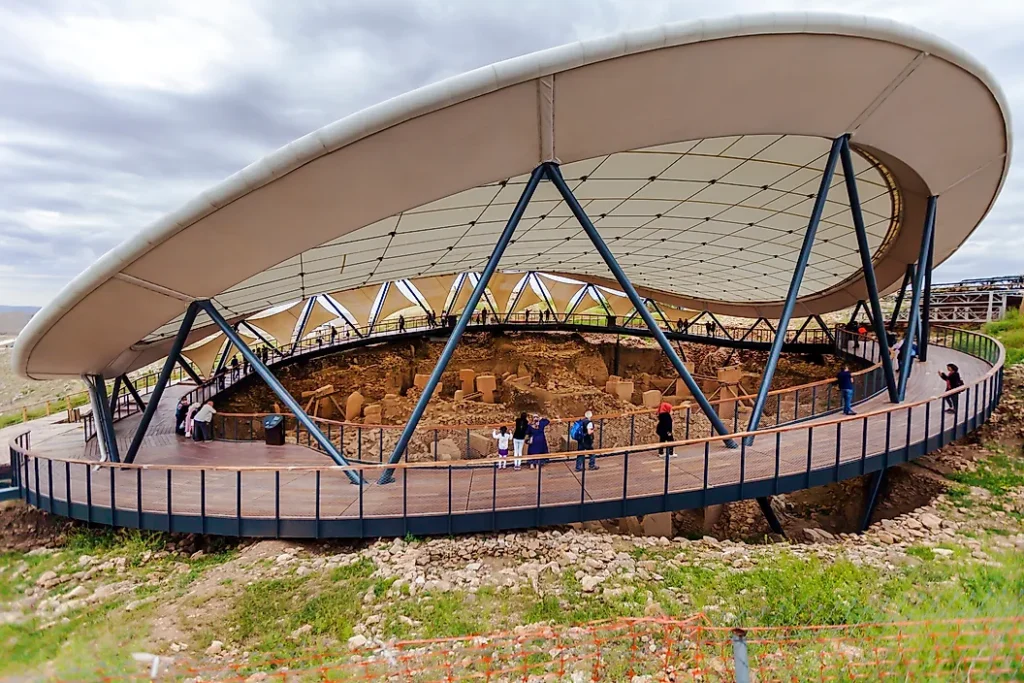
Tourists at the ancient site of Göbekli Tepe in Şanlıurfa, Turkey. Credit: Acsen
A little Background
Located in Anatolia (Turkish: Anadolu), also known as Asia Minor, a peninsula in West Asia that makes up the majority of the land area of Türkiye, Göbekli Tepe (English translation: Potbelly Hill) is a massive stone megalithic site built 11,600 years ago. The site is 6,000 years older than Stonehenge and predates the great Egyptian pyramids by 7,000 years.
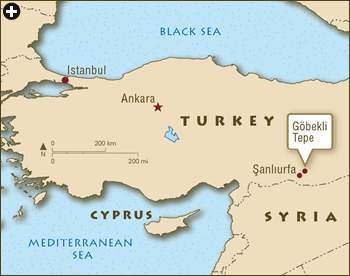
Credit: Wikipedia
Klaus Schmidt: Archeologist Extraordinaire
Discovered by German archeologist Klaus Schmidt in 1994, Göbekli Tepe is regarded as the most important archeological discovery in modern human history.
Surveying the region as part of his explorations, Schmidt realized that the huge hill was manmade. His meticulous research and excavations uncovered massive T-shaped limestone pillars, each weighing 10 to 20 tons, standing upright in circular enclosures. The pillars were carved with intricate reliefs of animals, lions, foxes, scorpions, vultures, and snakes, along with depictions of human arms and hands. The craftsmanship was extraordinary. These massive structures were extracted from a limestone quarry approximately 300 meters (980 feet) from the circular enclosures. How they were chiseled into 20-foot T-shaped monoliths with primitive tools, transported, andstrategically positioned in the enclosures is nothing short of mind-boggling, as is the perfection of the carved reliefs. Not to mention the astounding amount of mathematical knowledge, planning, organizational skills, and the enormous workforce required to build this highly advanced marvel of technology. One mistake in the carvings, one mishap in moving the stone blocks from the quarry and setting them in place, and the entire structure is ruined.
Schmidt’s findings threw a wrench in the prevailing textbook narratives, proving that our ancestors were far more sophisticated than anyone imagined as Göbekli Tepe predates agriculture, pottery, writing, and every other marker of civilization. Its discovery reveals that the people who built Göbekli Tepe were not agriculturalists (farmers, planters, growers); they were hunter-gatherers—people who primarily obtain food by hunting animals and gathering wild plants rather than farming or raising livestock. This indisputable evidence disproves decades of archaeological dogma that hunter-gatherers couldn’t create megaliths, and that you needed a fully formed agricultural society generating surpluses in order to engage in megalithic construction.
In 2016, I had the honor and pleasure of meeting Graham Hancock, a prolific writer, explorer, and researcher of ancient ruins across the globe. Hancock’s 2024 article (“Göbekli Tepe: Gradual evolution? Or transfer of technology? Or both?”) underscores the radical shift in historical thinking posed by the archeological treasures found at Göbekli Tepe:
Now we have a different view on history. Our findings change the perception, still seen in schoolbooks across the world, that settled life resulted from farming and animal husbandry. This shows that it begins when humans were still hunter-gatherers and that agriculture is not a cause, but the effect, of settled life…
Gateway to the Cosmos
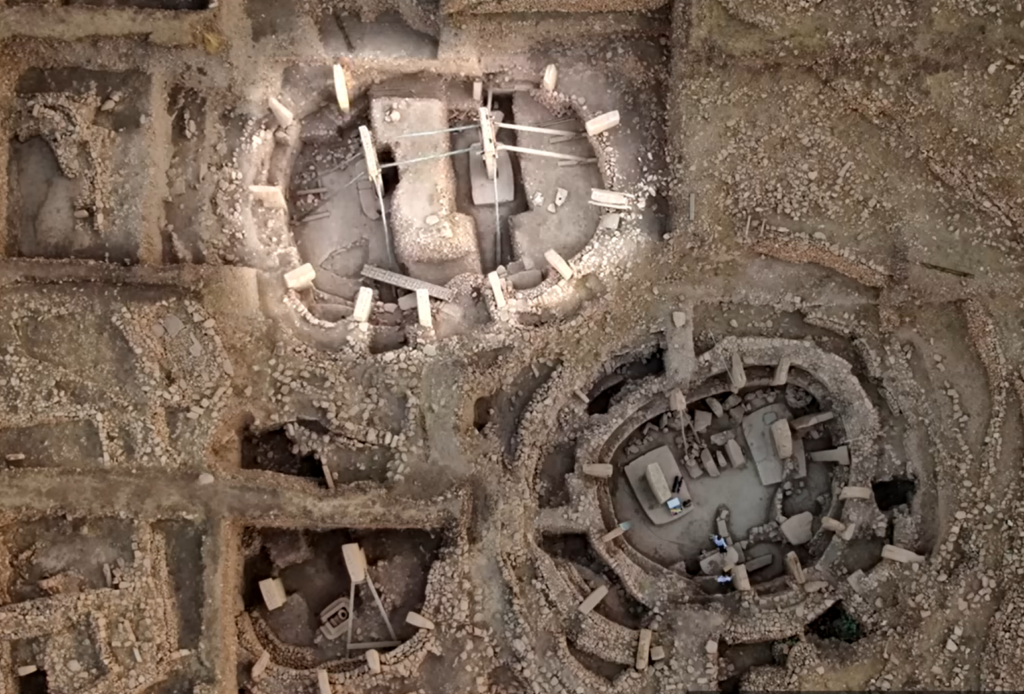
Göbekli Tepe’s Enclosure D (highlighted) featuring Pillar 43. Credit: Graham Hancock
A close examination of these monoliths reveal far more than decorative art created by a much later primitive culture, a premise espoused by many academics and mainstream archeologists. Similar to the pyramids in Giza, they represent grand-scale human constructions designed to align with astrological constellations across the universe.
Archaeo-engineer, researcher, and author Paul D. Burley offers a vivid description of Göbekli Tepe and its interior:
The structures at Göbekli Tepe are generally devoid of subdivided space other than what appear to be few peripheral hallways or storage areas. Rather than a temple of worship with a common area separated from a sacred space such as an alter [sic] or place of offering, the temples at Göbekli Tepe have the appearance of undivided open, circular structures except for two T-shaped pillars placed off center within each structure and aligned generally in a northeast-southwest direction. The open, rounded shape is similar to a modern-day arena or even the Roman coliseum where spectators observed games from peripheral seating while participants were located on the central floor area of each structure—like theatre in the round.
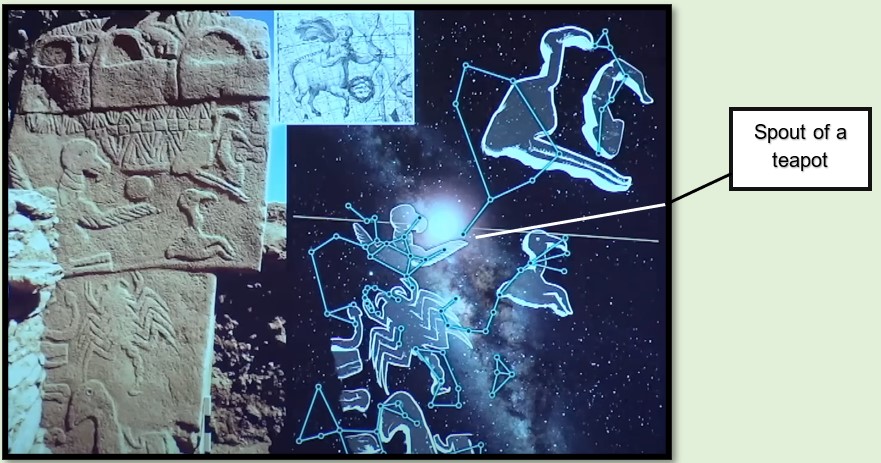
Pillar 43 located in Enclosure D at Göbekli Tepe. Credit: Graham Hancock
Burley’s contribution for understanding the significance of Göbekli Tepe is immeasurable. He was the first researcher to correlate Göbekli Tepe’s handcrafted bas reliefs to the cosmos, particularly the images depicted on Pillar 43 featuring the outstretched wing of a vulture that looks similar to the spout of a teapot.
From the archeological evidence gathered to date, there can be little doubt that Göbekli Tepe symbolizes an ancient cosmology, with the architecture representing the world and the carved figures symbolizing important aspects of the sun, stars and other features of the night sky.
The key to unlocking this early Neolithic puzzle is the circle situated at the center of the scene. I am immediately reminded of the cosmic Father—the sun. The next clues are the scorpion facing up toward the sun, and the large bird seemingly holding the sun upon an outstretched wing.
The “large bird seemingly holding the sun upon an outstretched wing” represents the constellation that we know today as Sagittarius. The location of the sun when it’s positioned over Sagittarius on a solstice happens twice in every 26,000-year period, commonly referred to as the equatorial precession. This happens once on the summer solstice and once on the winter solstice. These two events are separated by 12,500 years, half a cycle of a complete precession.
Based on Burley’s observations, we can conclude that the alignment of the sun over the constellation Sagittarius, positioned within the center of the Milky Way Galaxy, occurred at the summer solstice roughly 12,800 years ago, give or take a two-to-three-hundred-year window. This same alignment occurs 12,500 years later during the winter solstice which is happening now in our present epoch.
Why Is This Important?
This is a question I have often pondered, one that has given me pause and relief from trivial earthly distractions.
For some unknown reason, the builders of Göbekli Tepe constructed a temple, highlighting a time 11,600 years in their future which coincides with the findings of Paul Burley. Amazingly, Burley’s keen observations are affirmed by the work of author and preeminent Mayan researcher John Major Jenkins, who pointed out the 2012 date noted in the Mayan calendar predicting that the sun would align with the constellation Sagittarius directly in the center of the Milky Way, signifying the present-day winter solstice.
Equally noteworthy is the work of Martin Sweatman, writer, professor, scientist, and researcher at the University of Edinburgh, author of the 2013 book, Free History Decoded.
In a 2019 article, Sweatman decodes Pillar 43 and its close proximity to the Younger Dryas Impact Event (YDIE), a cataclysmic event that occurred sometime between 12,800 and 11,600 years BP (years Before Present). This event is said to have wiped out three-quarters of the world’s species resulting from a gigantic comet, estimated to be 100 plus kilometers (62 miles) in diameter, smashing into the earth’s surface at an estimated speed of 70,000 to 134,000 mph:
I had decoded Pillar 43. It almost certainly does represent a date using precession of the equinoxes and the constellations we are familiar with. But the date represented by the circle-sun on the eagle/vulture’s wing likely corresponds with the Summer Solstice at around 10,800 to 10,900 BC. Crucially, this date is very close to the date of the Younger Dryas Impact Event (YDIE).
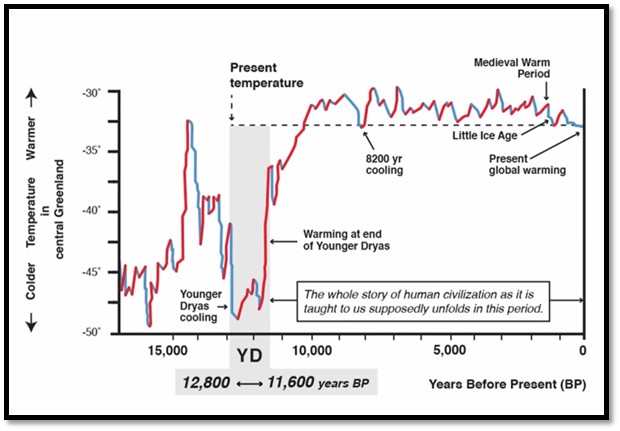
The Younger Dryas timeline. Credit: Graham Hancock. Author, Magicians of the Gods
Note: The above timeline depicts the sudden dramatic return to colder conditions—nearly as cold at the peak of the Ice Age 21,000 years ago. This sharp deep freeze lasted for 1,200 years until 9600 BC when the warming trend resumed.
Beyond its astrological signposts, Sweatman believes that Pillar 43 is a stone monument intended to provide invaluable information about what had occurred in the past and a warning to earth’s surviving inhabitants about what might occur in the future:
My view is that Pillar 43 is a kind of memorial to this pivotal event, and that Göbekli Tepe is perhaps the world’s first ‘university,’ or as Klaus Schmidt who began excavations at Göbekli Tepe put it, a ‘place of innovation.’ Possibly, Göbekli Tepe expressed many things, including profound astronomical knowledge and a new kind of organized religion formed out of the trauma of this cosmic impact event. It appears to have also been a place where many people met to . . . observe the skies, remember their ancestors, and perform rituals to protect their future. Through these activities, new generations were trained and instructed to pass on this knowledge.
Unearthing the Past . . . Layer by Layer
The soil, rocks, and organic matter that covered Göbekli Tepe and left the potbelly-shaped hill undetected for tens of thousands of years was not an accident. The circular structures and T-shaped pillars were deliberately buried by the region’s last inhabitants with the intent to preserve and create a historical record. By all accounts, the burial was a monumental project in and of itself. Fortuitously, the organic matter allowed Schmidt, his team, and other researchers to carbon-date materials found at the site, further authenticating the time frame of Göbekli Tepe’s inception and stages of construction.
As excavations continued, Schmidt’s team uncovered more enclosures. Each one deeper. Each one older. And each one more sophisticated than the last. The deeper layers were more advanced. How was this possible? Was this an anomaly?
Normally, archaeological sites reveal crude early attempts at pottery, sculptures and architecture overlaid by progressively more refined later work. At Göbekli Tepe, it was just the opposite. The oldest and deepest buried enclosures showed the most advanced construction, while the most recent layers showed decline, with smaller stones, less precise arrangements, and cruder carvings.
The hard truth is that Göbekli Tepe was not developing; it revealed signs of continued degradation. Schmidt struggled to explain this in published papers. He suggested that perhaps the site’s importance declined over time, leading to less effort being invested. But privately, he admitted this did not make sense. This incongruity baffled many mainstream archeologists and academics—highly paid skeptics who posed valid questions like, Why would a site considered important enough to build in the first place become less important? How could building skills decline rather than improve?
Over time, Schmidt’s perceptions had evolved. He had begun to think they were not looking at the beginning of something, but at the end. He said he thought Göbekli Tepe represented the final achievement of a culture that was already in decline. The people who built this had knowledge and capabilities that were being lost. He thought that Göbekli Tepe was built as a memorial, a warning, or an attempt to preserve something that was disappearing.
Killing the Messengers AND the Message
Credit: Jimmy Corsetti, Bright Insights
After Klaus Schmidt’s passing in 2014 at age 60, excavation at Göbekli Tepe came to a halt. In 2016, project management was transferred to the Doğuş Group, a prominent Turkish conglomerate encompassing more than 250 companies and 26,000 employees. Shortly thereafter, the Doğuş Groupannounced plans to turn Göbekli Tepe into a tourist attraction, a move that was clearly economic and one that ignited outrage in the archaeological community.
Regarding Göbekli Tepe’s management takeover, an article published by The Istanbul Chronicle reported:
Critics argue that after assuming control, Doğuş Group ceased excavation work and instead focused on developing the site for tourism. This included constructing a protective roof supported by steel columns, which created claims suggesting that the ancient stones have been pierced through. Such modifications have been criticized for potentially compromising the site’s archaeological integrity, emphasizing economic considerations over scholarly exploration [emphasis added].
What better way to destroy the atmosphere of probably the world’s oldest and most important archeological site and betray its intended connection to the universe than to construct a steel roof over the enclosures and T-shaped pillars. This is like inviting people to dinner and having them sit down in front of a sumptuous seven-course meal—blindfolded.
Strange Bedfellows
The Istanbul Chronicle went on to report:
Further complicating the situation, the World Economic Forum (WEF) reportedly intervened with Doğuş Group’s management of Göbekli Tepe. Following this intervention, all potential excavation activities were suspended. The site has since been covered with asphalt concrete, and heavy construction equipment, such as bulldozers and jackhammers, has been used to build roads. Additionally, there have been reports of afforestation efforts on the excavation site. This has raised alarm among archaeologists, as the roots of newly planted trees could penetrate and damage the ancient stones, making future excavations even more challenging fortifying the belief that the government is trying to hide something kept in Göbekli Tepe such as new beliefs or historical figures which contrasts with what humans know right now changing the history.
Ferit Şahenk, CEO and chairman of Doğuş Group has been honored and praised at the World Economic Forum, further fueling the controversy in now the Forum’s intentions. Critics question how such privileges can be justified in light of the stopped excavations and the alleged damage to the site.
The Possibilities Are Endless!
Given the world’s voracious appetite for money and ongoing efforts to commodify every plant, animal, and human being on the planet, I wouldn’t be surprised if Disney established a Göbekli Tepe walk-through surround-sound exhibit, or the developers in Las Vegas constructed a scaled-down replica of Göbekli Tepe next to the Eiffel Tower—free drinks and all-you-can-eat-SYF (stuff your face) buffet included.