
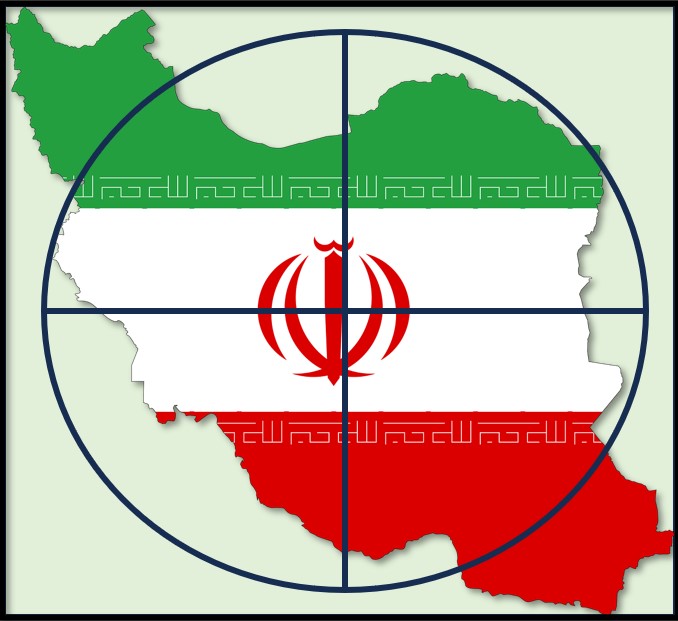
Credit: DGJ Pixabay
The Brookings Institution (TBI) is a Washington DC based think tank whose stated mission is to “equip decisionmakers with nonpartisan research and policy strategies to create a more prosperous and secure country and world.” TBI’s website also lists a number of goals, one of which is to “advance peace and security worldwide.”
It is unclear who asked the folks at Brookings to take on such a monumental challenge, but they have somehow managed to attract the attention of a diverse pool of notable organizations like the Bill & Melinda Gates Foundation, Google.org., Open Society Foundations, Amazon.com, and a surprising newcomer—the Norwegian Ministry of Foreign Affairs —(to name a few), all who have graciously donated millions of dollars in financial support.
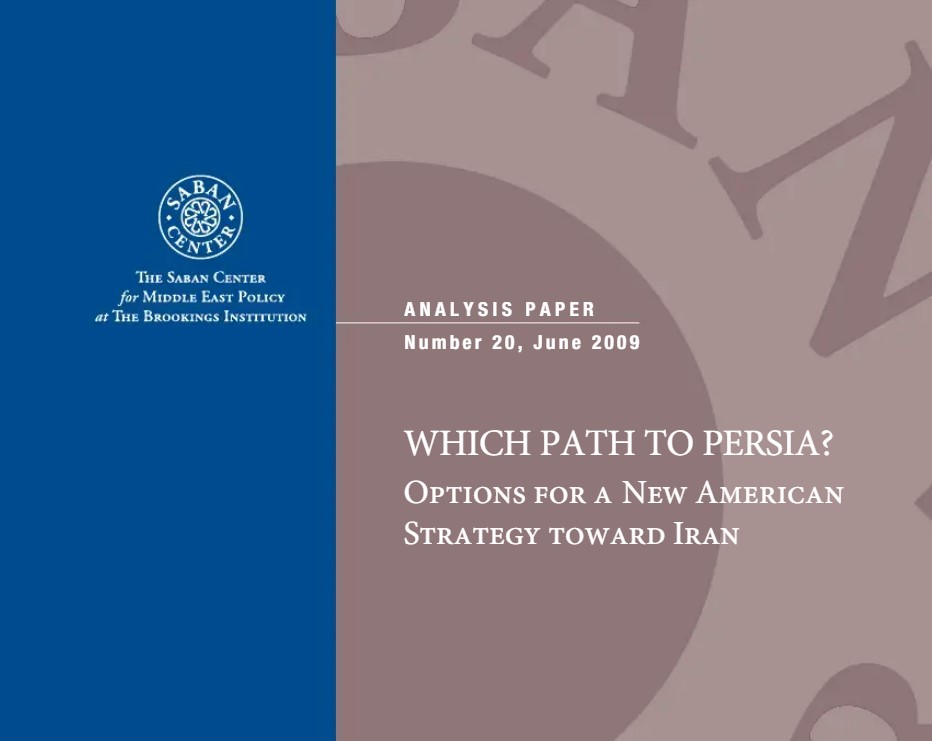
Which Path to Persia?
In their noble and courageous effort to “advance peace and security worldwide,” TBI published “Which Path to Persia?” This 2009, 170-page document is a top-to-bottom blueprint outlining a comprehensive strategy for the systematic political, economic, social, and military destruction of the sovereign nation of Iran, one of the remaining truly sovereign nations on earth.
From a writing perspective, this paper is impressive. The authors who crafted this demonic diatribe were able to frame Mafia-style pay-or-die strong-arm tactics and strategies into a digestible “give peace a chance” presentation for lawmakers, corporate elites, and foreign dignitaries unaccustomed to directly getting their hands dirty.
Credit: The Brookings Institution
With zero evidence, the document is written with the assumption that Iran has been developing nuclear weapons, an assertion that Iran has consistently denied. It was published at a point in time when Iran had already endured thirty years of economic sanctions imposed by the United States and other Western allies since the Iranian revolution of 1979, brutal sanctions targeting Iran’s oil, banking, and shipping sectors that continue today in the name of democracy.
The document pretends to offer nice-guy diplomatic solutions to bring Iran into the fold of Western powers and then suggests a number of treacherous options for toppling the Iranian government when diplomacy—as defined by the US—fails.
If one believes that Iran’s leaders are irrational or ideologically blinded to the point where they would use a nuclear weapon if they possessed one, then such a level of concern would likely cause one to support the most extreme options. This is not to say that one should be unwilling to try one or more of the diplomatic or regime change options first, or even try airstrikes before going all in. But if these efforts fail, such a perception of threat may well lead to the conclusion that the costs of an invasion are more than the risk that Iran will employ a future nuclear arsenal. [p.12]
The paper goes on to list a number of possible targets for an American air campaign against the Iranian nuclear program, “the most important ones to give a sense of what the US strikes would aim to destroy.” (p.79)
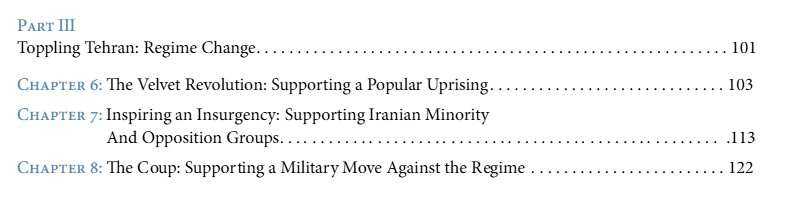
Table of Contents “Which Path to Persia?” Credit: The Brookings Institution
One could only imagine what the response of President Trump, the US Congress, the Central Intelligence Agency (CIA), the US Department of War, and the mockingbird mainstream media would be if Iran, China, and Russia had collectively produced a document titled “Which Path to America?” calling for the intervention and toppling of the US government, along with identifying specific targets within America’s borders. The already bloated US defense budget would balloon up to three trillion dollars and the mostly tuned-out American public would be flocking to local supermarkets, filling their shopping carts with stacks of toilet paper, and preparing to kiss their consumer asses goodbye.
The 2015 Joint Comprehensive Plan of Action (JCPOA)
In 2015, an agreement was reached with Iran, China, France, Russia, the UK, the US and Germany, commonly known as the Joint Comprehensive Plan of Action (JCPOA).
Catering to the overblown and fabricated agenda-driven concerns of Israel, the goal of the agreement was to limit Iran’s peaceful nuclear program, despite the fact that the use of nuclear weapons is in direct opposition to Iran’s religious and political beliefs and policies. This is quite a contrast to Israel’s development and possession of multiple nuclear weapons and delivery capabilities, the only country in that region that has consistently refused inspections by the International Atomic Energy Agency (IAEA).
In exchange for signing the agreement, the West agreed to lift a broad set of sanctions that had crippled Iran’s economy for years. The UN Security Council adopted Resolution 2231 that endorsed the agreement and established a timeline to roll back financial and economic restrictions.
It all sounded great until 2018 when Trump, the former Art of the Deal game show host elected president, unilaterally withdrew from the JCPOA agreement despite Iran’s full compliance with the agreement’s terms, evidenced by an independent report issued by the IAEA in September 2015. When asked about his decision, Trump remarked:
The Iran deal is defective at its core. If we do nothing, we know exactly what will happen. In just a short period of time, the world’s leading state sponsor of terror will be on the cusp of acquiring the world’s most dangerous weapons.
Throughout the 2010s, the US engaged in cyber operations against Iranian nuclear facilities, notably the Stuxnet computer virus aimed at disrupting Iran’s nuclear program. Iranian officials have displayed remarkable restraint, especially their measured response to the January 3, 2020 targeted assassination of Iranian Major General Qasem Soleimani who was killed by an American drone strike near Baghdad International Airport in Iraq, while travelling to meet Iraqi prime minister Adil Abdul-Mahdi. The hit was ordered by Trump during his first term in office, an action taken without Congressional approval.
👉 Just to be clear . . . that’s the assassination of a foreign official, in a foreign country, using an American aerial drone that has violated foreign airspace.
The Hidden Hands Behind a Manufactured Crisis
Since the publication of Brooking’s 2009 paper, there have been a number of attacks on Iran. The 12‑Day War of June 2025 is reported to have resulted in the deaths of 1,062 people including 786 military personnel and 276 civilians along with thousands wounded. The attack was a sucker punch that caught Iran off guard as they were led to believe that peaceful negotiations with the US and Israel were set to take place. Since then, what little trust Iran had in the United States has been lost and gone forever. Iran has ramped up its security and has been on high alert 24/7.
In early January 2026, Iranians took to the streets protesting astronomical inflation and high costs of living, a result of decades of debilitating Western economic sanctions aimed directly at the Iranian people. In late December 2025, the rial, Iran’s national currency, went into a free-fall collapse, exacerbating an already crumbling economy.
Iranian citizens took to the streets in nonviolent, peaceful protests. The demonstrations set the stage for the American CIA, British MI6, and Israeli Mossad operatives to move in and topple the Iranian government with the assistance of paid insurgents—merciless thugs armed to the teeth with orders to kill Iranian police and innocent civilians, burn mosques, and wreak havoc in and around major cities.
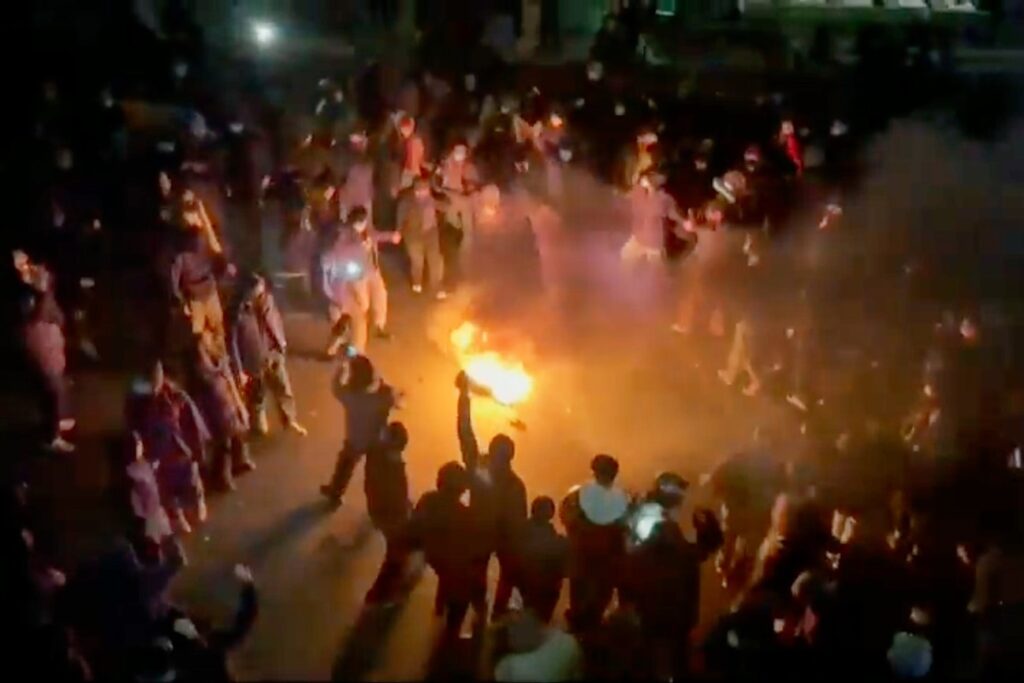
Cars set on fire during a protest on Saadat Abad Square in Tehran. Credit: The Independent UK
Brazilian geopolitical analyst and journalist Freddie Ponton has travelled the world covering global affairs, including the Middle East and Iran where he has reported extensively. In a recent article titled, “Iran Didn’t Erupt, It Was Ignited: The Hidden Hands Behind a Manufactured Crisis,” Ponton wrote:
When the first chants rose up in Tehran’s Grand Bazaar at the end of December 2025, they came from merchants worn down by real, everyday suffering: inflation eating away savings, a collapsing currency, and the unceasing grind of uncertainty. Yet within days, what began as a grassroots protest against economic hardship abruptly became a battleground for global geopolitical forces, reflecting not just Iran’s internal struggles but a war over narrative, power, and influence that spans continents.
The article goes on to identify the true culprits responsible for igniting tensions:
Almost immediately, the protests were framed in global media as a moral struggle for freedom, a narrative that dovetailed neatly with the interests of Western powers seeking to exert pressure on Tehran. Social media lit up with slogans like “Trump must intervene, save the Iranian people!” and “Free Iran!” messages that would soon be echoed by political elites in Washington. But behind these slogans lay something far less organic.
Western intelligence services, notably Mossad, CIA, and MI6, have a long history of operations aimed at destabilizing Tehran. According to regional reporting, counter‑government elements linked to foreign intelligence were embedded among pockets of unrest, with accusations that these operatives helped precipitate violence and chaos that went far beyond spontaneous civil discontent. The effect was not subtle: targeted sabotage of peaceful protests, direct engagement with activists, and narrative shaping via digital and human channels. These efforts were designed to transform economic protests into a broader political crisis, ripe for exploitation.
Iranian citizens were not only battling economic hardships; they were now struggling with a war of perception and misinformation, mainly emanating from sources like HRANA (also known as HRAI and HRA), an Iranian-based news outlet funded by the National Endowment for Democracy (NED), an organization set up as a civilian proxy for CIA regime‑change operations.
According to Mint Press News, HRANA received over $900,000 from NED in 2024, a nice chunk of cash in 2024 alone. The narrative Iranians were being fed by HRANA and a variety of other Western media news outlets were quite different from what Iranian citizens had been experiencing in real time on the streets of Tehran.
Technology’s Double-Edged Sword
As we now know, the attempt to subvert the protests and topple the democratically elected Iranian government was a colossal failure. Iran’s economic struggles persist but the protests have subsided and the streets are relatively calm, and daily life is back to normal.
The Iranians were able to thwart US/Israeli attacks by destabilizing communications leaving insurgent thugs directionless. The Forbes January 13th article (“Kill Switch—Iran Shuts Down Musk’s Starlink for First Time”)reported that Iran had successfully shut down internet services that US-backed militants were using to coordinate their actions. In doing so, they managed to jam and shut down Starlink terminals in critical regions across the country.
We have not seen this before. Iran’s digital blackout has now deployed military jammers, reportedly supplied by Russia, to shut down access to Starlink Internet. This is a game-changer for the Plan-B connectivity frequently used by protesters and anti-regime activists when ordinary access to the internet is stopped.
Despite reports that tens of thousands of Starlink units are operating inside Iran,” says Iran Wire, “the blackout has also reached satellite connections.” It is reported that about 30 percent of Starlink’s uplink and downlink traffic was (initially) disrupted,” quickly rising to more than 80 percent” within hours.
Ironically, the recent January attacks have served to galvanize the majority of Iranian people and their support for their government under the leadership of Khamenei.
What’s Next for Iran, the United States, Israel, and the World?
Unfortunately, the power-hungry, war-mongering lunatics in Washinton and Tel Aviv have not abandoned their psychotic plans to attack Iran and decapitate its leadership. Contrary to the belief of many Americans—particularly what’s left of the clueless remaining pro-Israel MAGA crowd—their motivations have nothing to do with freedom, democracy, political ideology, or women’s rights, and everything to do with regional control of the Middle East and access to valuable resources and global trade routes—period; full stop.
The Wall Street Journal is reporting that “after pulling back from strikes on Iran, President Trump is still pressing aides for what he terms “decisive” military options. Trump canceled all meetings with Iran’s leaders and implored Iranians protesting their government to overthrow the regime and declared that “help is on its way.”
Keeping Trump’s word, the USS Abraham Lincoln Carrier Strike Group (the “help”) traveled from the South China Sea and has arrived in the Gulf of Oman—fueled, armed, and ready for action, along with US Navy destroyers, tankers, and squadrons of US Air Force F-15E fighter jets, all in preparation for an all-out air assault on Iran.
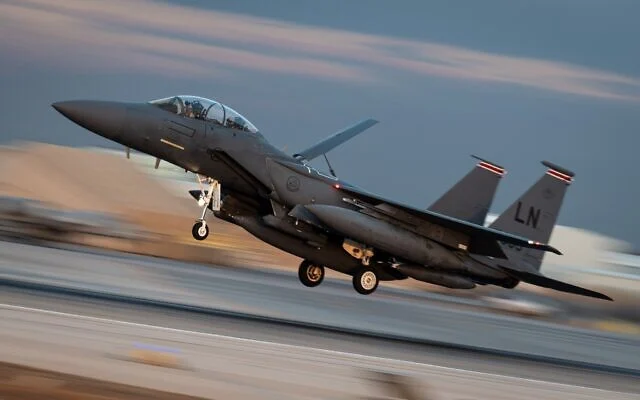
A US Air Force F-15E Strike Eagle assigned to the 494th Expeditionary Fighter Squadron lands at an unnamed base in the Middle East, January 18, 2026 Credit: CENTCOM/X
Already battle hardened from the war in Ukraine, the Russians are not sitting back and taking America’s actions lightly, especially after they discovered the CIA’s direct and unconscionable involvement in the drone attack on the residence of Russian President Vladimir Putin. Iran is a close Russian ally, and the toppling of Iran poses an enormous threat to Russian trade and national security in that region.
Defense Security Asia (DSA) is reportingevidence of shipments of Russian arms into Iran:
Defense observers increasingly assess that the recent pattern of repeated Russian heavy cargo flights into Iran is not coincidental but instead reflects a deliberate logistics effort linked to the airlift of Mi-28 “Havoc” attack helicopters purchased by Tehran.
This assessment is reinforced by the close alignment between the types of transport aircraft employed, the sustained tempo and routing of the flights, and the distinctive logistical footprint typically associated with transferring disassembled rotary-wing combat platforms, mission equipment, and supporting systems.
Fuck Around and Find Out
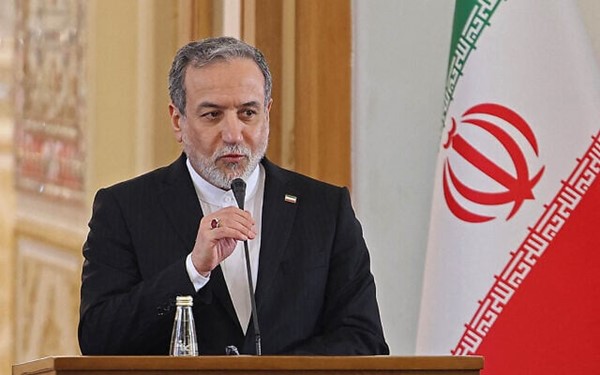
Iranian Foreign Minister Abbas Araghchi Credit: ATTA KENARE / AFP
At a January 18, 2026 press conference held in Tehran, Iranian Foreign Minister Abbas Araghchi, joined by Fuad Hussein, his Iraqi counterpart and one-time Iranian foe, pulled no punches when stating Iran’s unequivocal position regarding future US and Israeli attacks on Iran:
Unlike the restraint Iran showed in June 2025, our powerful armed forces have no qualms about firing back with everything we have if we come under renewed attack. This isn’t a threat, but a reality I feel I need to convey explicitly, because as a diplomat and a veteran, I abhor war.
An all-out confrontation will certainly be ferocious and drag on far, far longer than the fantasy timelines that Israel and its proxies are trying to peddle to the White House. It will certainly engulf the wider region and have an impact on ordinary people around the globe [emphasis added].
It is no secret to US and Israeli military planners that the Iranians have invested heavily and developed superior missile capabilities, evidenced by Iran’s response to Israel’s June 2025 air strikes on Iran’s nuclear sites. The Iranians fired back and easily penetrated the Israeli Iron Dome, once considered to be impenetrable. Iranian missiles caused significant damage to Tel Aviv and sent a loud wake-up call to Mr. Netanyahu and his cabal of Zionist genocidal gangsters.
Iran’s long-range missile program includes intercontinental ballistic missiles (ICBMs) that have a range of up to 10,000 km, approximately 6,213 miles, capable of reaching targets on the East Coast of the United States with near pinpoint accuracy. The Iranian stockpile is estimated to be in the vicinity of 2,000 to 3,000 missiles, including Medium-Range Ballistic Missiles (MRBMs) that have an estimated range of up to 2,000 km, roughly 1,242 miles.
If Iran has no qualms about firing back with everything they have, the damage to American military bases in and around the Middle East would be devastating, not to mention the fact that an all-out Iranian missile attack would turn most of Israel—a 1,291-mile hop, skip, and a jump from Tehran—into a fucking parking lot, leaving tens of thousands of Israelis dead and wounded.
The Dire Straits
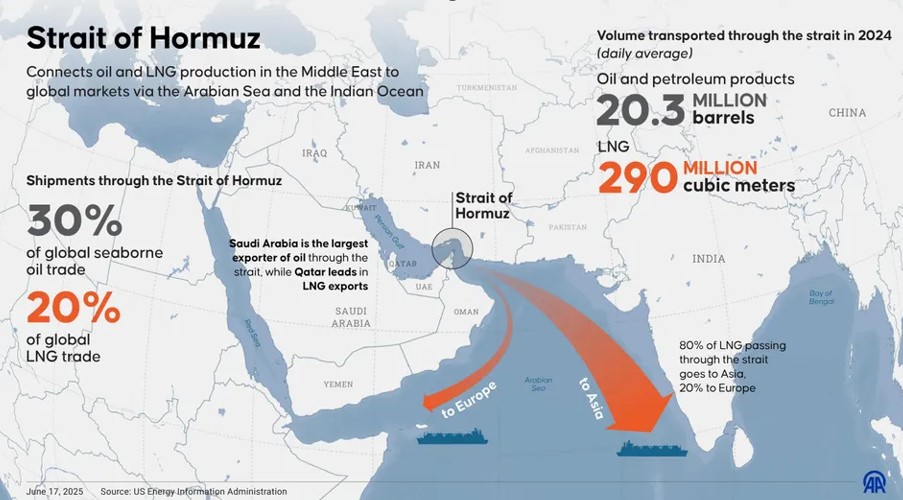
A map connecting oil and LNG production in the Middle East to global markets via the Arabian Sea and the Indian Ocean. Credit: Murat Usubali/Anadolu Anadolu
Stockpiles of ICBMs and MRBMs aside, Iran’s most powerful trump card (no pun intended) is their control of access to the Strait of Hormuz, considered to be the world’s most vital energy choke point.
Bordered largely by Iran and just 21 miles wide at its narrowest point, the Strait of Hormuz handles the transport of nearly 20 percent of global oil supply. It is also a critical artery for liquefied natural gas (LNG) transit. Many key energy-producing countries rely on the Strait of Hormuz to get their products to market including the US, Qatar, and Australia, the three major global LNG producers, each maintaining about 20 percent of the global market.
If Iran’s parliament follows through with their June 2025 vote to close the Strait of Hormuz, the impact on global energy markets and the world economy would be immediate and catastrophic. Oil prices may well blow up to $100 a barrel and LNG spot prices, currently hovering around at $5.275,could reach double digits seen in the early 2000s in the wake of 9/11 jitters.
In addition to triggering a wider military conflict that would assuredly draw Russia and China into the mix, closing the Strait linking the Persian Gulf to the rest of the world would ignite a collapse of the currently declining US dollar and other currencies, and increase inflation in the US and other nations trading in US Dollars. At the consumer level, prices at the gas pump would skyrocket along with the already out-of-control costs of food, rent, and healthcare.
What Is to Be Done?
I don’t have any quick answers, but I’m confident of two things: 1) It took us decades of greed, corruption, tyranny, and the plundering of the earth’s resources to arrive at the shithole we presently find ourselves in, and 2) the capitalist system is rigged to the rafters and people have willingly agreed to accept the delusion that we can somehow vote our way out of this.
The world is plagued with a cabal of psychotic globalists willing to risk the future of humanity, prepared to stop at nothing to maintain their concentration of power and control at any and all costs. Trying to convince them to reverse course is like trying to convince a half-blind, 450-pound diabetic with gout, high blood pressure, and a heart condition—committed to a steady diet of big-gulp soft drinks and processed foods—to consider a healthier lifestyle and quit their forty-year, two-pack-a-day smoking habit.
The illusion of freedom will continue as long as it’s profitable to continue the illusion. At the point where the illusion becomes too expensive to maintain, they will just take down the scenery, they will pull back the curtains, they will move the tables and chairs out of the way and you will see the brick wall at the back of the theater.
— Frank Vincent Zappa; American composer, musician, and film director.
It is now 2026, and it is abundantly clear that the illusion of freedom has dissipated and the world is staring at the naked brick wall at the back of the theater.