
PFAS in our food system and the Environmental Protection Agency’s dedication to protect corporate interests at the expense of the environment and the health of Americans.

Credit: Center for Food Safety
America is witnessing a refreshing transformation. Under the current US regime, government departments and agencies have finally taken on the long overdue task of reevaluating and changing their names to reflect their true mission and purpose.
Take, for example, the branch of government once referred to as the Department of Defense, now the Department of War. A simple tweak, yet deadly accurate—a name that every country in the world that has experienced American bombers and fighter jets bombing the shit out of their people, in the service of democracy and self-defense, has these same people taking to the streets shouting, Hallelujah! The Yanks have finally come clean!
Now rumors are flying around our nation’s capital saying that the Environmental Protection Agency (EPA) is about to follow suit and change their name to the EDA, the Environmental Degradation Agency.
This is a welcome change for millions of Americans who have seen their lands destroyed by toxic pesticides, weather geoengineering, and environmental disasters like 9/11 and the East Palestine, Ohio train derailment and have incurred severe health issues as a result of the EPA’s ineffective policies and oversight and their cozy relationship with chemical-producing corporations.
PFAS In Our Food System
Like every other bullshit campaign promise, the Trump administration is reversing course on PFAS “forever chemicals” and pushing to roll back critical protections against PFAS contamination in drinking water and signaling to polluters that corporate interests once again come before public health.
PFAS—short for per- and polyfluoroalkyl substances—are a class of thousands of fluorinated chemicals linked to cancer, infertility, birth defects, immune system suppression, liver damage, and other serious health harms. They are called “forever chemicals” because they resist breakdown and can persist in the environment for years or even decades.
In late 2025, the EPA approved cyclobutrifluram, a new PFAS pesticide, for widespread agricultural use. Their website clearly states:
Cyclobutrifluram is expected to be a useful addition to Integrated Pest Management (IPM) programs. It can be used in rotation with other nematicides to reduce potential resistance in crops and turf. IPM provides an effective and environmentally sensitive approach to pest control that focuses on pest prevention and using pesticides only as needed. This approach can be applied in response to pest monitoring where alternative nematicide pesticides are applied prior to planting. By incorporating cyclobutrifluram, farmers gain an additional tool to manage crops and increase food production for our country.
EPA has not identified risks to human health in the risk assessment conducted in support of cyclobutrifluram registrations. EPA also conducted an ecological risk assessment and biological evaluation under the Endangered Species Act and has already completed an informal consultation with the U.S. Fish and Wildlife Service (FWS). FWS concurred with EPA’s determination that the uses of cyclobutrifluram being registered are not likely to adversely affect endangered species or critical habitats, and EPA finalized the biological evaluation [emphasis added].
Isocycloseram
Isocycloseram is another type of PFAS that poses an equally alarming threat to humans, animals, insects, and the environment.
This insecticide was approved for use on hundreds of fruits, vegetables, and grain crops despite the EPA’s own finding that bees and other pollinators could be exposed to levels up to 1,500 times the agency’s chronic harm threshold simply by collecting nectar and pollen from treated fields.
Isocycloseram also harms aquatic insects at extremely low concentrations and has been linked in animal studies to skeletal malformations in fetal rats, reduced sperm counts, liver damage, and possible cancer risks.
One out of every three bites of food we eat depends on pollinators. Needless to say, approving a pesticide this toxic to bees for use across millions of acres of farmland is reckless and unlawful, not to mention insane.
The Center for Food Safety (CFS)
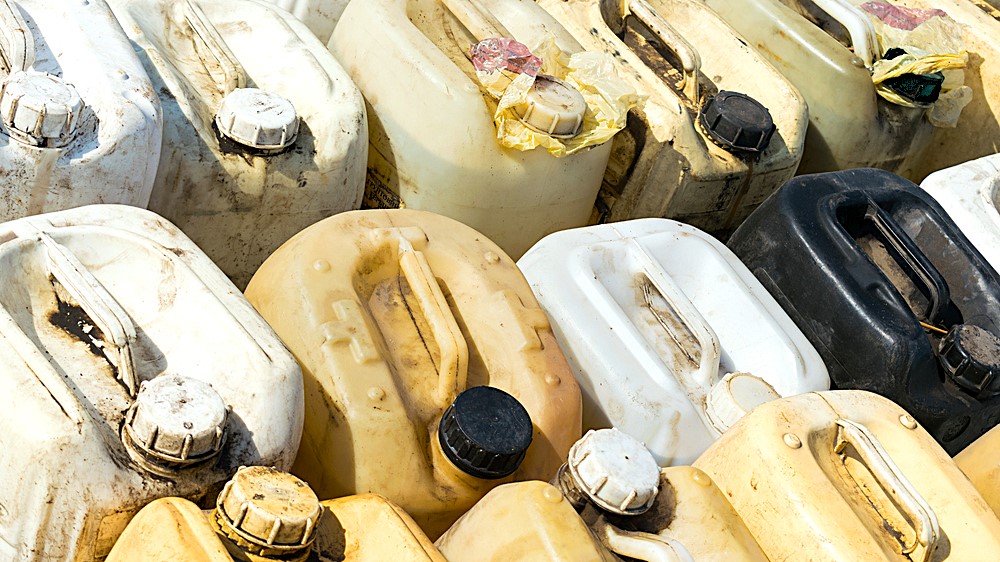
Toxic fluorinated plastic containers used to store PFAS. Credit: Center for Food Safety
The Center for Food Safety is a national organization on a specific mission “to empower people, support farmers, and protect the earth from the harmful impacts of industrial agriculture.” In an illuminating article (“PFAS in Pesticides”), CFS revealed the following:
A peer-reviewed study published in July 2024 confirms that PFAS are increasingly being added to U.S. pesticide products, contaminating waterways and posing potential threats to human health.
The study’s major findings include:
- 14% of all U.S. pesticide active ingredients are PFAS, including nearly one-third of active ingredients approved in the past 10 years.
- PFOA and PFOS, thought to be among the most toxic PFAS chemicals, have been found in some pesticide products, likely from the leaching of fluorinated containers these products are stored in, and other unknown sources.
- PFAS ingredients in pesticide products have been found in streams and rivers throughout the country.
- Pesticides can accumulate PFAS from multiple sources, leading to mixtures of different PFAS chemicals in containers.
- The current U.S. pesticide regulatory framework is not equipped to adequately identify and assess the risks from PFAS in pesticides.
The article further disclosed:
Currently, there are around 200 pesticide ingredients that are currently registered which qualify as PFAS chemicals. PFAS are also present in the containers which pesticides are stored in, where they eventually leach into the product. About 20% of pesticides are stored in these types of fluorinated plastic.
This is especially concerning to our vulnerable pollinator populations as a recently published study showed that exposure to an extremely small concentration of PFAS can stop all brood rearing, effectively killing the colony.
Enter the EPA. Or Rather, EXIT!
The CFS asked a simple question and provided a simple, direct answer:
So, what actions has the EPA taken to protect us from PFAS?
In April 2024, they set strict drinking water standards for PFOA, PFOS, and a few other PFAS chemicals. They’ve also taken steps under the Resource Conservation and Recovery Act (RCRA) and the Toxic Substances Control Act (TSCA), but not under the Federal Insecticide, Fungicide, and Rodenticide Act (FIFRA), our main pesticide statute. EPA has prohibited a few PFAS pesticide ingredients that are “inert” but has not taken any action regarding the “active” ingredient. The ingredients they have acted on are old and rarely used to begin with. Essentially, they’ve done nothing to protect us from PFAS in pesticides, and therefore, PFAS in our food system [emphasis added].
What Can Be Done?
The Center for Food Safey is at the forefront in the legal battle to stop the use of PFAS in our food system. Information about how you can help support this organization can be found here.
There isn’t a person living in the continental United States who hasn’t been exposed to PFAS to one degree or another. Below is a list of useful resources to help rid your body of PFAS.
There isn’t a person living in the continental United States who hasn’t been exposed to PFAS to one degree or another. Below is a list of useful resources to help rid your body of PFAS.
- New Study: Oats Detox Forever Chemicals
- Best Way to Detox Microplastics – And It’s Shockingly Simple | Dr. William Li
- How Microplastics Are Ruining Your Health And What You Can Do About It – Dr Rhonda Patrick
Additional Resources:
- How One Company Secretly Poisoned the Planet
- 3M PFAS documentary | Everywhere & Forever: Blood. Water. And the Politics of PFAS
- The Hidden Chemicals Destroying American Farms | VICE Special Report
- PFAS – “Forever chemicals” in drinking water | DW Documentary
- Forever Chemicals PFAS, PFOA, PFOS, BPA, Explained Clearly